a guide to the British education system

British Boarding School

The British Education System can be very different and potentially confusing for new overseas parents looking to enrol their child at school in the UK, but it’s important that both parents and students understand this system to clarify entry requirements, study options available, and navigate the educational framework. In this guide, we will provide a clear step-by-step introduction to each stage of British education and answer any common questions.

how does the British education system work? UK school years explained

null

The education system in the UK is divided into four main phases:

  • Primary education: The first phase of formal schooling for children aged between 4/5 and 11.
  • Secondary education: The phase of schooling that follows primary education, covering children between the ages of 11 and 16.
  • Further education: A non-compulsory phase of education where individuals can choose to further develop their knowledge and skills.
  • Higher education: Refers to a university where individuals can choose to take undergraduate and postgraduate degrees.

Children progress through school in year groups. For example, Year 1, Year 2, Year 3, Year 4, and so on. Primary School includes Years 1-6, and Secondary School includes Years 7-11.

The education system in the UK further breaks down into "key stages", which are the blocks inside the primary and secondary education phases. Each key stage has its own curriculum and learning goals. They break down as follows:

Primary Education

  • Key Stage 1: 5 to 7 years old
  • Key Stage 2: 7 to 11 years old

Secondary Education:

  • Key Stage 3: 11 to 14years old
  • Key Stage 4: 14 to 16 years old

Most schools follow the National Curriculum, which outlines what students should be learning at each key stage.

null

what are key stages?

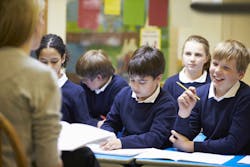
Students sitting in class, raising their hands to answer a question

Key Stages are milestones for monitoring students’ progress throughout formal schooling (primary and secondary education). They refer to different stages of the national curriculum, which is a set of subjects and standards that most primary and secondary schools use. Key stages break the curriculum down into manageable chunks for easier learning.

Key Stage 1 (KS1) for ages 5 - 7

Key stage 1 covers Year 1 and Year 2. They focus on foundational skills in numeracy and literacy, such as basic reading, writing, and maths. The introduction of science, art, and physical education also occurred here.

Key Stage 2 (KS2) for ages 7 - 11

Key stage 2 covers Years 3 to 6. This stage builds on the foundations set in KS1 and expands to subjects like science, art, PE, geography, history, and music. This stage also focuses on expanding critical thinking and problem-solving.

Key Stage 3 for ages 11 - 14

Key stage 3 starts in secondary school, covering Years 7 to 9. It focuses on deepening knowledge and understanding in core subjects like maths, English, and science, and includes further subjects in KS2 as well as modern foreign languages, technology, and computing. This stage is important for broadening students’ horizons and preparing them to make choices for further education in KS4.

Key Stage 4 for ages 14 - 16

Key stage 4 covers Years 10 and 11. This is where students will prepare and take their GCSE exams, which will help them with their choices for further education or job seeking. KS4 allows students to tailor their education to their interests and further aspirations.

UK education levels

boys in classroom

Education in the UK is split into different phases or levels, and encompasses key stages 1-4. The law requires children to start full-time education at the beginning of the school term following their 5th birthday. However, they can start earlier at 4 in the reception class.

primary school education (KS1 & KS2)

a classroom where chairs have been placed on top of the desks

Primary school education in the UK begins at age 5 and continues until age 11, comprising key stages one and two under the UK educational system.

Some primary schools are split up into Infant and Junior levels, which are usually separate schools on the same site.

The infant age range (Key Stage 1) is from age 5 to 7. The Junior age range (Key Stage 2) is from age 7 to 11.

The year groups at the primary school level are:

  • Year R (Reception) (age 4 – 5)
  • Year 1 (age 5 - 6)
  • Year 2 (age 6 - 7) The year when SATs testing takes place for Key Stage 1
  • Year 3 (age 7 - 8)
  • Year 4 (age 8 - 9)
  • Year 5 (age 9 - 10)
  • Year 6 (age 10 - 11) The year when SATs testing takes place for Key Stage 2

In primary school, children will cover core subjects such as English, maths, and science, as well as other key subjects like art and PE. During the primary years, schools help children nurture social and emotional skills as well as traits like teamwork, resilience, and creativity.

secondary school (KS3)

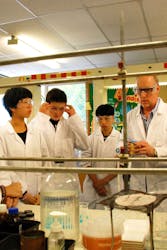
science class of students

Years 7 and 8 are the first two years of secondary school education in the UK for students aged 11 to 13. In some independent schools, these years are included in the Junior School, in others, they are part of the Senior School.

Under the UK school system, all students study core subjects:

  • English
  • Maths
  • Sciences
  • A humanities subject
  • A modern language

Besides these, each school has a list of optional subjects, such as:

  • Art
  • Music
  • Drama
  • Latin
  • Sport science
  • Design technology
  • Computer science

Students may choose a few subjects that interest them.

In some independent schools, students sit the Common Entrance Exam in year 7. There are 3 examination sessions, in November, January and May/June. The transition from Junior to Senior School (from year 8 to year 9) may be conditional upon the Common Entrance Exam results in those schools.

Year 9 is very important in the British school system, as many students make the transition from Junior School to Senior School. It is also a very good foundation for the GCSE programme, and it is an entry point to all schools.

secondary school (KS4)

School children in class

In Years 10 and 11, students prepare to take their GCSE (General Certificate of Secondary Education) exams. These exams assess their proficiency in various subjects, forming the basis for future academic pursuits.

In the UK school system, students in Year 10 and 11 study between 9 and 12 subjects. Some of them are compulsory (English, Maths, Sciences, Humanities, a Modern Language, etc.), and some are chosen by each student according to their abilities and preferences.

Following the examinations, students receive their GCSE Certificates.

The chosen subjects and the GCSE results are very important for their Further Studies (A-Level or IB) and for their University admission.

Intensive 1-year GCSE

Some schools offer a 1 Year GCSE programme in Year 11 for international students seeking a school education in the UK. These intensive, one-year courses are available for students aged 15 plus, with the appropriate academic level from their own country. Fewer subjects are studied (maximum 6).

These programmes are ideal for students in Year 11 who need to get back on track, have moved schools, or want to fast-track to sixth form, A-Levels, or other further education.

IGCSE

The IGCSE (International General Certificate of Secondary Education) programme is an international academic qualification equivalent to a UK GCSE. It prepares international students for A-Level and/or IB, and is a globally recognised qualification.

Students study between 5 and 7 subjects, English, Maths and Science being included. Each school has a list of available subjects for IGCSE students. At the end of Year 11, students take exams in each subject studied and receive IGCSE Certificates.

further education

null

Further education is any studying or training that happens after secondary school has been completed. Generally, this includes college or sixth form, where you will study A-Level qualifications, vocational courses, or apprenticeships. Further education is a stepping stone for specific degrees, jobs, or careers.

A Levels

In the UK school system, once a student reaches the age of 16, they can start a 2-year programme which leads to A (Advanced) level examinations. Students specialise in 3 or 4 subjects, which are usually relevant to the degree subject they wish to study at university. A levels are state examinations and are recognised by all UK universities and by institutions worldwide.

At the end of further college or sixth form and following relevant exams, students receive A-level Certificates.

International Baccalaureate (IB)

The IB is an educational foundation that offers a continuum of challenging, high-quality programs for students aged 3 to 19.

Those who would like to study more than 3-4 subjects may continue their studies in a broader number of subjects with the International Baccalaureate Diploma Programme, offered by some independent schools.

During the IB, students study 6 subjects, 3 at higher level (HL) and 3 at standard level (SL). Each school offers different subjects at different study levels (HL/SL). The IB programme also includes a compulsory Core programme consisting of Theory of Knowledge (TOK), Extended Essay (EE) and Creativity, Activity, Service (CAS).

Students take written examinations on each subject at the end of their courses.

a girl using her laptop

Vocational Courses

Vocational courses are practical, skills-based programmes designed to prepare students for specific careers or further study. Vocational courses offer a range of qualifications, such as NVQ, BTEC, and apprenticeships. They focus on learning by doing rather than studying exams. Subjects include:

  • Construction
  • Health and beauty
  • Business
  • IT
  • Creative media
  • Education and care
  • Hospitality
  • Engineering
  • Services

International students aged 16+ can either choose a state sixth form college or a college of further education. Both offer GCSE and A-level courses for students, while further education colleges also provide foundation and diploma courses. All colleges can prepare students for entry to a  UK university or any university in the world.

Bright World works with a number of state colleges in the UK, which provide a multitude of vocational and academic courses. These courses can enable students to pursue their chosen career or to gain a place at a university of their choice.

The British school system also extends to BTEC courses, which are designed for students who would like to develop practical knowledge and skills in a specific subject, including:

  • Business
  • Psychology
  • Engineering
  • Sport
  • Art & Design

Focussing on practical, skills-based learning, the BTEC students are assessed during the course. After each unit, students are assessed through assignments, tasks or tests, and not at the end of the programme, as it happens with A-Level students.

T Levels

T Levels launched in 2020, and are 2-year-long courses which are taken after GCSEs and are equivalent to 3 A Levels. They’ve been developed to meet the needs of certain industries and prepare students for entry into skilled employment. They offer students practical and knowledge-based learning either at school, college, or through work experience.

higher education

null

Higher education follows further education, and generally involves university or specialised colleges. It can lead to qualifications such as bachelor's degrees, master's degrees, and doctorates, with the main goal of providing specialised knowledge and training to improve career prospects.

University

The UK offers a higher education experience for students who want higher academic qualifications. Universities provide a diverse range of degree programmes across various disciplines from arts and humanities to sciences and engineering.

In university, students engage in rigorous academic study, research, practical applications, and more to help their academic and career pursuits. It also fosters personal growth, critical thinking, and independence, preparing students for future leadership roles and career opportunities in future.

From age 17, international students can opt to study one-year foundation programmes, instead of A levels or IB. These courses lead to private examinations that are an alternative to A levels. Foundation courses at colleges are recognised by universities with whom they have partnerships.

Some universities also offer foundation courses that lead to their own degree programmes.

Bright World has partnerships with a number of colleges and Pathway providers and can help place students into Foundation and Diploma courses in London and across the UK.

Undergraduate

A British bachelor's degree normally takes three years to complete, and most are awarded at the honours level. Examples of first degrees are:

  • BA (Bachelor of Arts)
  • BEng (Bachelor of Engineering)
  • BSc (Bachelor of Science).

State colleges offer some 2-year vocational diplomas that grant exemption from the first and sometimes second year of a degree programme. Some private tutorial colleges offer a one-year diploma programme equivalent to year 1 of university. Students taking 1-year diplomas are awarded second-year entry at some universities.

Postgraduate

Postgraduate courses in the UK education system are very intensive. This means that the courses are usually much shorter than in other countries.

A master's degree typically takes 12 months to complete, for example, an MA - Master of Arts and an MEng - Master of Engineering. An MBA (Master of Business Administration) is a high-profile Master's course which can take 2 years. Applicants will usually be high-achieving with at least 2 years of managerial experience. A PhD research degree in the UK can take between 2 and 7 years.

null

UK University Placement

A UK university placement is an assessed period of professional work experience that forms part of their degree. It’s sometimes called a ‘sandwich year’, or ‘year in industry’. It allows students to build professional networks and gain experience working in the UK within their area of study.

For expert advice on UK and US university entry, Bright World has teamed up with Education Advisers Ltd, whose experienced consultants offer a full range of Higher Education services for international students. These range from complimentary advice on the best University Foundation courses, to bespoke Oxbridge and Medical School coaching and mentorship programmes.

You can visit their websites at www.educationadvisers.co.uk or call +44 1622 813870 for further information.

Pathway Courses at University

If international students need to improve their English language or study skills before attending a UK university, pathway providers offer unique foundation courses which often lead to direct degree-level entry upon completion. There are several private companies that operate Foundation and Diploma programmes on the campuses of UK universities. Often, these courses offer accelerated access to undergraduate degrees.

types of schools in the UK

null

Grammar Schools & Academies

Grammar schools and academies receive funding from the government and are run by a trust. They have more control over how they do things rather than community schools.

These schools are inspected by Ofsted and have to follow rules on admissions, special education needs, and exclusions.

Boarding Schools

Bright World works almost exclusively with privately funded schools and colleges. A boarding school is a residential school where pupils live and study during the school year. There are approximately 500 boarding schools across England, Wales, Scotland and Northern Ireland.

UK boarding schools offer pupils an outstanding education, helping them to develop their skills and progress to university. All UK boarding schools have to meet strict government standards on the quality of their teaching, facilities and student care.

Many UK boarding schools combine beautiful, centuries-old buildings with a mix of modern classrooms and traditional architecture. The excellent facilities help make living and learning a great experience, and pupils will improve their English skills while they study.

Tutorial Colleges

A tutorial is a small class of only a few students, in which the tutor (a lecturer or other academic faculty member) gives individual attention to the students. They start at age 15 and have a more flexible programme range, focusing on fast access to a UK university.

Many of the independent private sixth form colleges in Oxford, Cambridge and London work on a 'tutorial system' and are often referred to as 'tutorial colleges'. The tutorial system originates from Oxford and Cambridge Universities and is a highly regarded and much-tested system. It is still used today and is the cornerstone of an 'Oxbridge' education.

State Boarding Schools

A state boarding school is one where you pay for boarding, and the education is free. The government pays for the education as it would at any other state school in England.

Admission to state boarding schools in the UK is limited to children who are nationals of the UK and are eligible to hold a full UK passport, or those who are nationals of other European Union countries or those who have the right of residence in the UK. Please note that the holding of a BN(O) passport does not make the child eligible for a state boarding school in the UK.

F E Colleges

An FE college is an institution that provides education for those above school age (age 16). There are many types of FE colleges, including sixth form colleges, specialist colleges and adult education institutes.

FE Colleges are state-run and, as such, those members of the EU joining can benefit from free education. There is also a competitive fee structure available for non-EU international students.

assessments & qualifications

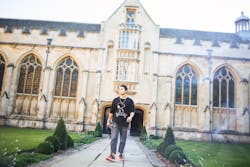
Student at Cambridge University

UK students take assessments at different stages of their education to monitor progress and prepare for the next stage of their education.

SATs

SATs are taken by children in key stage 1 and key stage 2 and assess basic skills in English and maths.

GSCE

GCSEs are taken by students in key stage 4 and are the main qualification that is taken at the end of secondary school. Students will typically study 9-12 subjects and are graded A*-G.

A-Levels

A-Levels are two year courses for students aged 16-18 and are usually studied in sixth form or college. Students generally specialise in 3-4 subjects relevant to their goals in their career or university education.

International Qualifications

International students can take qualifications like the IGSCE (equivalent to the UK GCSE for international students) or IB diploma (a broader curriculum usually studying 6 subjects including Theory of Knowledge, Extended Essay, and Creativity, Activity, Service (CAS). These qualifications are recognised worldwide.

types of student visas

null

International students coming to the UK require the correct visa in order to study legally. This depends on the student’s age and level of education that they will be pursuing.

Understanding these options is important for families in order to plan ahead and prepare the necessary documents.

Child Student Visa (ages 4–17)

For students attending:

  • Independent boarding schools
  • Fee-paying day schools
  • Certain accredited institutions

Students must:

  • Have an unconditional offer
  • Show proof of funding
  • Have parental consent
  • List a nominated guardian (this can be Bright World)

Student Visa (ages 16+)

For students enrolling on:

  • A-Levels
  • IB Diploma
  • Vocational courses (BTEC, foundation programmes)
  • University degrees

Students must receive a CAS (Confirmation of Acceptance for Studies) from a licensed sponsor (school, college, or university). Students at boarding school must nominate a guardian if they are under 18. They will also need a guardian at university which is a service that Bright World can offer.

Most Visas take 3-6 weeks to process.

need help navigating the UK education system?

null

Choosing the right school, college, or university pathway in the UK can feel incredibly confusing and overwhelming, especially for international students and families. AT Bright World, we can help you through every step from choosing the right school to supporting with admissions, visas, guardianships, and progression.

Contact us today if you’re considering studying in the UK, and we can guide you through every step.

FAQs

Do international students need a guardian?

What is the difference between a Child Student Visa and a Student Visa?

Can international students go to UK state schools?

How do I choose the right UK school for my child?

How do UK school holidays work for international students?